
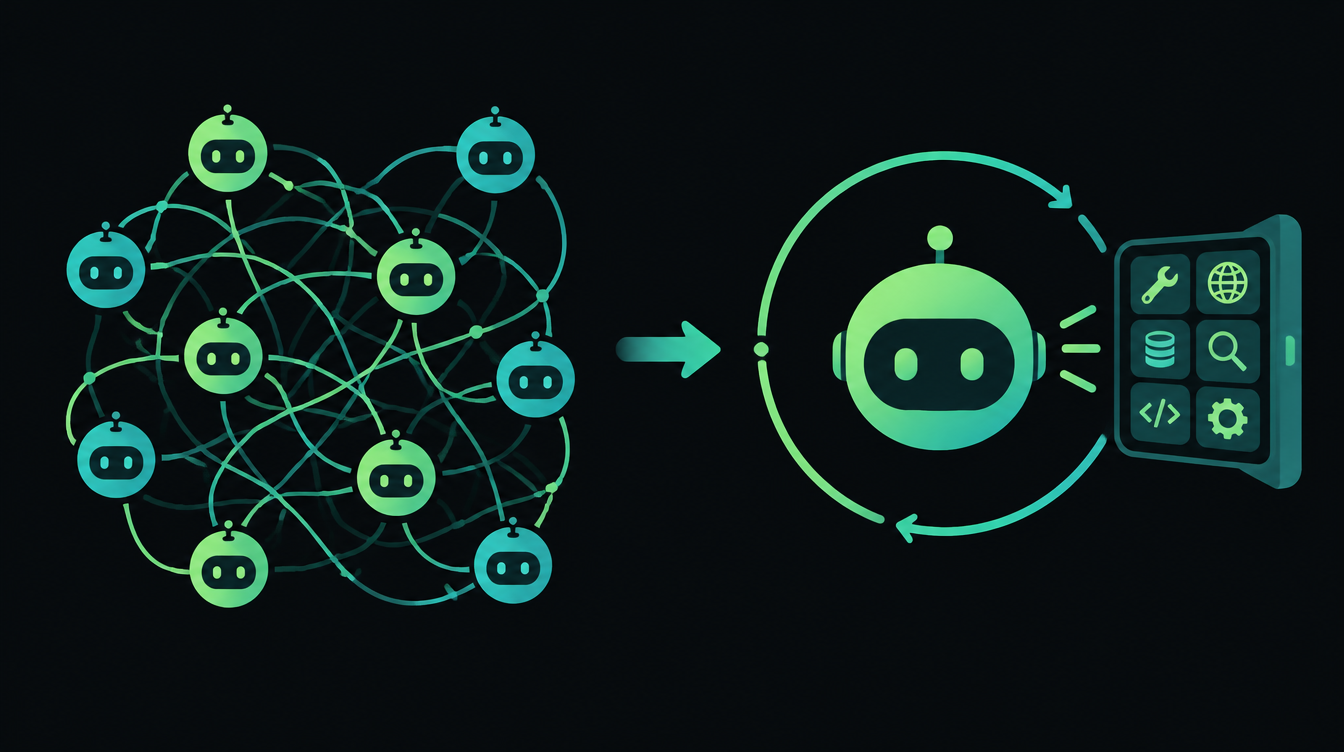
Should you build one AI agent or a team of agents? In single agent vs multi-agent design, Anthropic's guidance from 22 October 2026 is clear: start with one agent loop that loads skills and tools as it needs them, and split work into subagents only when you can measure a problem that splitting fixes. In its tests, a single agent with skills often beat both a one-big-prompt design and a subagent design on quality, and often at lower cost and latency per task.
That reverses the advice many teams followed through 2025, when an "orchestrator plus specialists" setup was the default picture of a serious agent. This report looks at what Anthropic found, where multi-agent designs lose time and quality, when they still earn their place, and how to fold an existing system back into one loop without breaking it.
What Anthropic published, and why it matters now
The article, "When to fold subagents into your main agent loop" by Diane Sarkis, argues that using fewer subagents, with context and tools disclosed progressively, can improve quality while cutting cost and latency.
It gives a few hard numbers. One customer's evaluation found a single agent loop ran roughly 2x faster than its multi-agent harness. Tool choice "tends to degrade" once a system prompt holds more than 30 to 50 tool definitions. And the article says newer models, starting with Opus 4.5, can manage far more within one loop than earlier ones could.
The timing fits a wider shift. The same week, the Agentic AI Foundation took in Anthropic's Agent Skills as an open format (VMblog, 22 October), which means the "skills loaded on demand" pattern is becoming a shared standard.
Two ways to build the same agent
Take a support agent for a distributor: it answers order status questions, checks invoices, raises returns and escalates complaints. There are two common designs.
The multi-agent version looks tidy on a whiteboard. Each specialist has a short prompt and a few tools, and the orchestrator decides who handles what.
The single-loop version keeps one agent in charge. Each area (orders, invoices, returns) becomes a skill: a folder of instructions and scripts the agent reads only when the task needs it. Data access becomes a small set of tools. Anthropic's article describes one customer-facing agent with about a dozen specialist subagents, where, by its estimate, 4 to 5 thin data tools with one system prompt and firm output guardrails would have covered most of the use case.
Where multi-agent systems lose time and quality
Most of the problems sit in the handoffs between agents.
Every handoff is a summary
When the orchestrator passes a task to a subagent, it passes a description, not its whole context. If the customer said earlier "this is the third time I'm asking", the returns subagent may never see it. The answer comes back technically right and tone-deaf.
Every hop adds model calls
An orchestrator call, a subagent call, a result back, often a check. Each hop adds waiting time, which fits the 2x runtime gap in Anthropic's example. On a voice agent, callers hear every pause, as our breakdown of where voice agent latency goes shows.
Routing becomes its own failure point
With many specialists, the orchestrator has to pick correctly every time. A wrong route fails quietly: the invoices agent gets a returns question and answers the part it understands.
Nobody owns the whole behaviour
Anthropic recommends that one small central team own the system prompt and end-to-end quality. In multi-agent builds, each specialist often gets its own owner, and nobody tests the full conversation.
When subagents still make sense
The article is not against subagents. It lists three conditions where they are worth keeping:
- A single loop shows measurable degradation from context bloat.
- Several tasks need to run in parallel, each with a fresh context that can be thrown away afterwards.
- One agent struggles to pick the right tools, or the system prompt has conflicting instructions.
It also says subagents work well for verification, parallel work and modular permissioning. That last one matters for business systems. If one part of the job can move money, it can sit in a separate agent with its own narrow permissions, a pattern we covered in how to set AI agent permissions safely.
How to fold a multi-agent system back into one loop
Anthropic's article gives a five-step process, and ships a single-agent-loop-kit on GitHub with a guided workflow and a demo on a mock system. In plain terms:
Step 1: Build a small end-to-end eval before touching anything
Grade final answers against a rubric. The article says even 10 golden examples are enough to start. Cover every chain of agents that runs together in production and every rule the agent must not break.
Step 2: Merge specialists that already belong together
Specialists that chain on each other's output, touch the same data, or are often called together are the first to merge. In the support example, orders and returns read the same order records, so they go first.
Step 3: Call the remaining subagents as tools
Instead of handing the whole conversation to a subagent, the main agent calls it like a function and gets a result back. The article keeps full handoffs only for a subagent that must talk to the user directly.
Step 4: Fold one subagent at a time
Turn its prompt into a skill and its API calls into MCP tools. Compare eval results with and without it, check which tasks flipped from pass to fail, and only then decide whether to keep it.
Step 5: Run every task more than once
This is the step teams skip. In the article's sample support agent, a folded change broke a process in one run out of two. A single green test run would have hidden that.
The other direction: fixed procedures instead of free choice
Not every vendor is betting on one free-thinking agent. On 21 October, Kognitos launched "AI Employees" for finance and banking with 61 roles backed by 515 standard operating procedures, plus an agent called Quill that drafts new procedures for a person to approve (Kognitos launch announcement). It is in preview for Kognitos customers.
Kognitos frames its approach around an agent that follows the same approved procedure every time, instead of deciding each step on the fly. For finance work that has a practical benefit: when an auditor asks why an invoice was paid, there is a written procedure to point to.
The two approaches agree on the main point. Fewer moving parts, written procedures and checks you can audit matter more than the number of agents. For an invoice or payment process, I would want the procedure written down and approved by a person, whichever architecture runs it.
Decision table: one loop or several agents?
| Situation | Start with | Why |
|---|---|---|
| Support or sales agent answering one customer at a time | One loop with skills | One context keeps the full conversation; fewer calls means faster replies |
| Voice agent on phone calls | One loop with skills | Every extra model hop adds a pause the caller hears |
| Agent with more than 30 to 50 tools | Group tools into skills first; split only if tool choice is still poor | Anthropic says tool choice tends to degrade past that range |
| Research across many sources at once | Parallel subagents | Each search gets a fresh context that is thrown away afterwards |
| Any step that moves money or deletes data | Separate subagent with narrow permissions, plus human approval | Limits what a mistake or a bad instruction can reach |
| Checking another agent's output | A separate verifier | Anthropic lists verification as a good use of subagents |
| Existing multi-agent system that works but is slow or costly | Eval first, then fold one subagent at a time | You keep what works and measure every change |
Questions to ask before you buy or build an agent
- How many agents does this system run, and why is each one separate?
- Which steps can move money, send messages or delete records, and who approves them?
- Is there an end-to-end eval, and how many times is each test run?
- What is the reply time for a typical request, and how many model calls does it take?
- Who owns the whole system prompt?
If a vendor can't answer the first question in one sentence, the design is probably more complicated than the job. Our AI agent development page explains how we scope agents, or book a free 30-minute audit.
Architecture matters less than picking the right first job for an agent. Next Monday we go back to basics with a step-by-step guide to automating customer onboarding in a small business: the welcome message, the documents, the first-week check-in, and where a person still has to step in.
Want to know what you could automate?
Book a free 30-minute automation audit. We'll look at one process with you and tell you honestly whether automating it is worth it. See how we work or browse our services.
Book a free auditGet posts like this in your inbox once a week. Subscribe to NXT Weekly.
Keep reading
How to Automate Quotations in a Small Business, Step by Step
A seven-step setup for sending accurate quotes within the hour, routing big discounts to the owner and following up until the buyer answers, with a checklist and INR costs.
Tally vs Zoho Books: Which Is Better for Automating a Growing Business?
A side-by-side look at TallyPrime and Zoho Books for Indian businesses that want to automate invoices, approvals and reporting, with 2026 prices in rupees.