
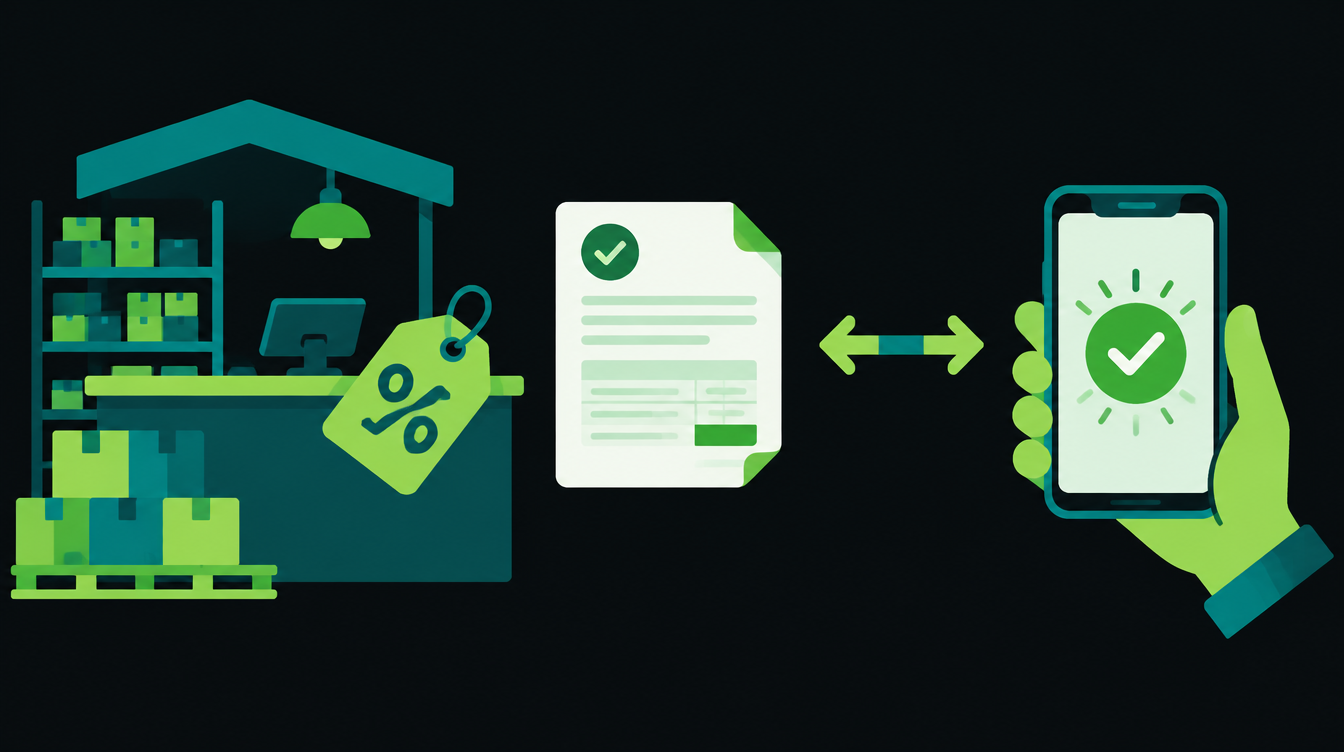
From 1 November 2026, a post-sale discount under GST can reduce the taxable value of a supply without being agreed before the sale. Two conditions remain: the supplier issues a credit note, and the buyer reverses the input tax credit (ITC) that relates to the discount.
The change comes from sections 153 to 155 of the Finance Act 2026, brought into force by Notification 03/2026-Central Tax dated 26 October 2026, as TaxGuru's summary with the amended section text sets out. It affects any business that gives year-end schemes, volume rebates or settlement discounts, which means distributors, wholesalers and manufacturers most of all.
What changed in the post-sale discount rule
| Before 1 Nov 2026 | From 1 Nov 2026 | |
|---|---|---|
| When the discount is agreed | At or before the supply, under an agreement | Can be decided after the sale |
| Link to specific invoices | Required | Not required |
| Credit note | Issued by the supplier | Issued by the supplier under section 34 |
| Buyer's ITC | Reversed by the buyer | Reversed by the buyer, and the exclusion depends on it |
According to Taxonation's explainer on Notifications 03 to 05 of 2026, the old test still applies to supplies and credit notes from before 1 November 2026. Check older schemes with your CA.
In practice, a scheme decided in December for goods sold in October can now reduce GST, as long as both the credit note and the buyer's reversal happen. The weak point has moved to the buyer: if they do not reverse the ITC, the discount does not come out of your taxable value.
If your AATO is ₹10 crore or more, the credit note is also an e-invoice document that must reach the IRP within 30 days, as covered in Monday's guide to automating invoice processing.
A five-step credit note workflow
- Record the discount decision. When a scheme or settlement is approved, log the buyer, the invoices it covers, the amount and the reason in one sheet or your CRM.
- Raise the credit note. Create it in Zoho Books or Tally against the buyer, with the discount and the GST on it shown separately. Generate the IRN if e-invoicing applies to you.
- Send it with a confirmation request. Email and WhatsApp the PDF to the buyer's accounts contact and ask them to confirm the ITC reversal in writing, using the message below.
- Chase automatically. If there is no reply in 7 days, send one reminder, then flag the credit note for your sales person to call. A small workflow can do this from the same sheet.
- Close it at month-end. Mark each credit note as confirmed or open, and give that list to whoever prepares your return.
Steps 3 and 4 suit a WhatsApp automation setup, because the reminder and the buyer's reply can both happen in a chat the buyer already uses.
Buyer confirmation message you can copy
Email version:
Subject: Credit note CN-[number] dated [date]: please confirm ITC reversal

Dear [Name],

Please find attached credit note CN-[number] dated [date] for
Rs [amount] plus GST of Rs [GST amount], towards [scheme or reason]
on invoices [invoice numbers].

Under section 15(3)(b) of the CGST Act, as amended from
1 November 2026, this discount is excluded from the value of supply
once the input tax credit linked to it is reversed at your end.

Could you please confirm by reply, by [date], that ITC of
Rs [GST amount] has been reversed, and in which return period?

Thank you,
[Your name], [Company], [Phone]
WhatsApp version:
Hi [Name], sharing credit note CN-[number] for Rs [amount] + GST Rs [GST].
Please reverse ITC of Rs [GST] and reply here with the return period
once done. Thank you, [Your name], [Company]
Who should set this up first
- Distributors and stockists that pass on brand schemes after a quarter closes.
- Manufacturers that give volume rebates at year end, including units in Nashik's industrial areas.
- Any business that settles a dispute with a discount instead of a return.
If you run one of these in Nashik, our automation team in Nashik can set the flow up with you. This post explains the rule change; confirm how you account for each discount with your CA.
The discount rule is one of several GST changes that started on 1 November. In Friday's AI Pulse we cover the rest, including a faster way to cancel a GST registration and new reverse-charge rules for some scrap, plus the AI updates from this week that matter to a small business.
Want to know what you could automate?
Book a free 30-minute automation audit. We'll look at one process with you and tell you honestly whether automating it is worth it. See how we work or browse our services.
Book a free auditGet posts like this in your inbox once a week. Subscribe to NXT Weekly.
Keep reading
How to Automate Quotations in a Small Business, Step by Step
A seven-step setup for sending accurate quotes within the hour, routing big discounts to the owner and following up until the buyer answers, with a checklist and INR costs.
Tally vs Zoho Books: Which Is Better for Automating a Growing Business?
A side-by-side look at TallyPrime and Zoho Books for Indian businesses that want to automate invoices, approvals and reporting, with 2026 prices in rupees.